You do not need a backyard or a strong stomach to turn your kitchen scraps into black gold. Most people avoid indoor composting ideas because they fear the “rot” factor. They worry about bad smells, fruit flies, and messy leaks. It makes sense. Nobody wants a kitchen that smells like a landfill.
If your compost smells, something is wrong with the science. You can turn food waste into plant food right in your kitchen without any odor. In this guide, you will learn seven specific ways to compost that use fermentation, drying, or helpful bugs to keep your air fresh.
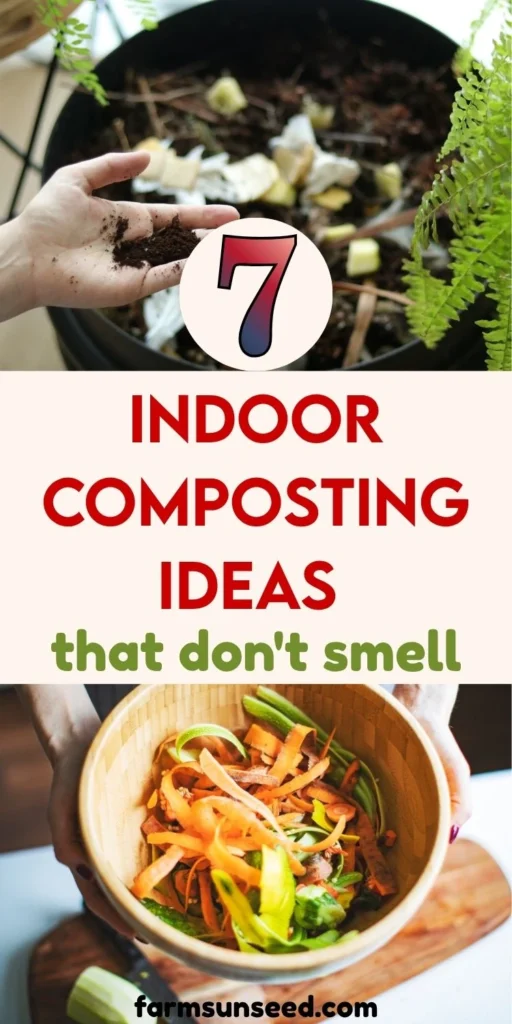
7 Indoor Composting Ideas That Don’t Smell
1. Use The Bokashi Method To Pickle Scraps

This method does not actually rot your food. It picks it. You use an airtight bin and a special mix called Bokashi bran. This bran is full of tiny microbes that eat the waste in an environment without oxygen.
Why it works:
Since the bin is sealed tight, no smells escape. The microbes go to work on your kitchen scraps and lower the $pH$ level. Scientific data shows that the $pH$ drops to around 4.0. This acidic environment is great because it kills bad germs but keeps the good stuff.
Unlike other bins, Bokashi can handle meat, cheese, and small bones. Because it is anaerobic composting, you do not have to turn it or add air.
Pros
- Fits under the kitchen sink.
- Processes meat and dairy easily.
- Works very fast.
Cons
- You have to buy the bran regularly.
- You still need to bury the “pickle” in soil later.
Pro-Tip: Drain the “Bokashi tea” from the bottom of the bin every few days. You can dilute this liquid and feed it to your houseplants for a huge nutrient boost.
2. Get An Electric Countertop Composter

If you want the 2026 tech solution, this is it. These countertop composters are about the size of a bread machine. They do not use bugs or worms. Instead, they use heat and grinding blades to dry out your waste.
Why it works:
These machines use a food recycler process that reduces waste volume by up to 90% in just a few hours. To keep things smelling fresh, they use HEPA and activated carbon filters. These filters trap volatile organic compounds (VOCs). That means even if you put in old broccoli, your kitchen stays clean.
Pros
- Zero smell thanks to carbon filters.
- No fruit flies.
- The finished product looks like dried coffee grounds.
Cons
- They use electricity.
- The units can be expensive.
Pro-Tip: Check if your city offers a rebate for electric composters. Many urban waste programs now help pay for these to keep food out of landfills.
3. Start a Worm Bin with Breathable Fabric

Worm composting is a classic for a reason. Red Wiggler worms are the stars here. They eat your scraps and leave behind vermicompost, which is the best fertilizer on earth.
Why it works:
In the past, people used plastic bins that got soggy and smelly. Modern kits use breathable fabric. This allows air to move through the bedding material. This is vital because oxygen prevents the bad smells from starting. Soil experts suggest keeping a Carbon to Nitrogen (C: N) ratio of about $30:1$. This means for every handful of food, you add a big handful of shredded paper.
A single pound of worms can process 0.5 lbs of waste every day. Just remember that your worms are your roommates. If they are happy, your home stays fresh.
Pros
- Creates the highest quality fertilizer.
- Very low cost to maintain.
- Educational for kids.
Cons
- Worms are living things that need care.
- You cannot feed them citrus or onions.
Pro-Tip: Freeze your fruit scraps for 24 hours before giving them to the worms. This kills any fruit fly eggs that might be on the peels.
4. Try The Trench Method in Large Planters

If you have big indoor plants like a Fiddle Leaf Fig, you can compost right in the pot. This is called trenching. You dig a small hole in the dirt, drop in your chopped scraps, and cover them up with at least three inches of soil.
Why it works: The soil acts as a natural filter for smells. Soil microbes break down the food and feed the plant roots directly. This is great for indoor gardening because it builds soil health without moving heavy bags of dirt.
Pros
- No extra bins needed.
- Feeds your plants for free.
Cons
- Only works for small amounts of food.
- Hard to do in small pots.
5. Hide Sub-Surface Micro-Bins

Think of this as a tiny worm bin that lives inside a larger planter. You bury a small tube with holes in it into the soil. You put your food in the tube, and the worms crawl in and out of the holes to eat. This keeps the mess contained and the smells buried deep under the dirt.
6. Use The Frozen Scrap Collection Trick

This is the easiest way to start. You keep a bin in your freezer for all your scraps. When the bin is full, you take it to a local drop-off point or put it in your bigger bin. Since the food is frozen, it cannot rot or smell. It is a perfect bridge for people who are not ready for a full system yet.
7. Use Aerobic Stackable Worm Towers

These towers use vertical space. You add food to the top tray. Once the worms eat everything, they crawl up to the next tray. This keeps the air moving and prevents the bottom from getting packed down and stinky.
Why Indoor Composting Works?
When food goes to a landfill, it gets crushed with trash. It rots without air and creates methane. About 14% of global methane comes from landfills. By using these indoor composting ideas, you stop that gas from forming.
From high-tech electric bins to the simple science of Bokashi, you can now cleanly manage waste. It is an easy win for your home and the planet. Pick one method that fits your space and start today. Your plants will thank you.