Watching a retirement portfolio drop is uncomfortable when you are still earning a paycheck. It can feel very different after retirement, when the same account may be paying for groceries, property taxes, vacations, and part of next month’s electric bill.
The 3-bucket strategy tries to solve that problem by separating money needed soon from money meant to stay invested for years.
The real value is not that three buckets can stop losses. They cannot. The goal is to give retirees another source of spending money when selling long-term investments during a downturn would be especially painful.
What the 3-Bucket Strategy Actually Does
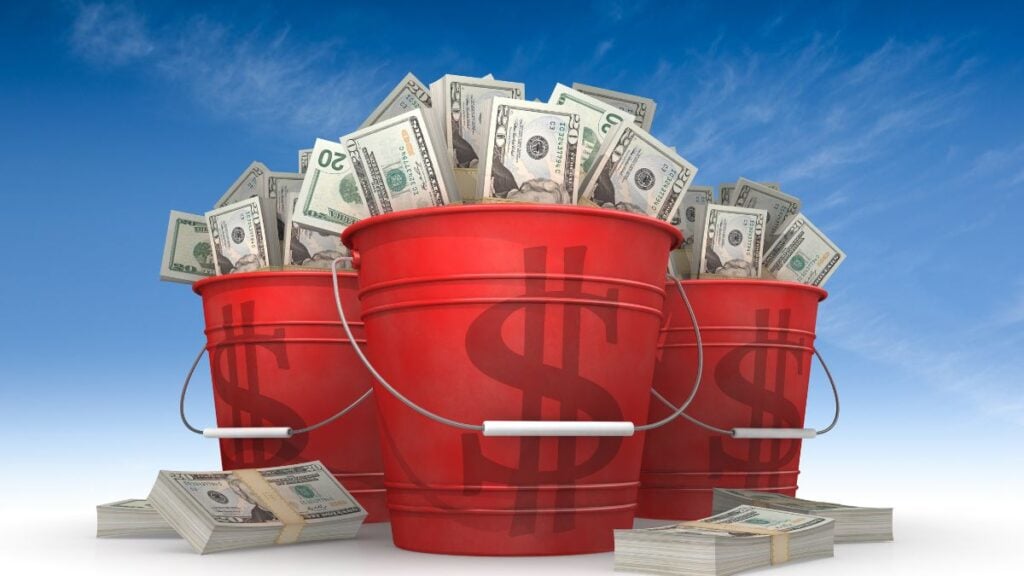
A bucket strategy divides a retirement portfolio according to when the money may be needed. Cash and lower-volatility assets handle nearer spending, while stocks and other growth assets receive more time to recover from market declines.
There is no single official three-bucket formula. Schwab has illustrated versions such as one to three years, four to seven years, and eight-plus years, while Morningstar has discussed structures with one or two years of portfolio withdrawals in cash, several additional years in bonds, and the balance in equities.
The following is a simple way to understand the jobs rather than treating the time periods as fixed rules.
| Bucket | Main Job | Possible Holdings | Typical Time Focus |
|---|---|---|---|
| Bucket 1 | Pay near-term portfolio withdrawals | Cash and highly liquid holdings | Roughly the next 1–2 years |
| Bucket 2 | Provide stability and refill Bucket 1 | High-quality short or intermediate bonds and similar lower-risk assets | Several years after Bucket 1 |
| Bucket 3 | Pursue long-term growth | Diversified stock investments and other long-term assets | Money not expected to be needed for many years |
The point is not to create three unrelated investment accounts. The buckets together still form one retirement portfolio, and the total mix of stocks, bonds, and cash still needs to match the retiree’s risk capacity, goals, and time horizon.
That distinction matters because putting a “Bucket 2” label on an investment does not make it safer. Diversification and sensible asset allocation remain important regardless of the labels used.
The Bucket Calculation Many Retirees Get Wrong
A retiree spending $72,000 a year does not necessarily need $144,000 in cash simply because two years equals $144,000. First determine how much of the $72,000 must actually come from investments.
Consider a hypothetical retired couple spending $72,000 annually. Suppose Social Security and a pension provide $48,000, leaving only $24,000 that must come from their portfolio.
Their calculation could look like this.
| Hypothetical Annual Cash Flow | Amount |
|---|---|
| Total household spending | $72,000 |
| Social Security and pension income | $48,000 |
| Amount portfolio must provide | $24,000 |
| Two years of portfolio withdrawals | $48,000 |
In this simplified example, a two-year Bucket 1 target based on portfolio withdrawals would be about $48,000, not $144,000. That difference leaves another $96,000 available for whatever investment mix the couple’s overall plan calls for.
The calculation becomes more complicated when income changes from year to year. Taxes, large home repairs, travel, charitable giving, RMDs, part-time work, and one-time expenses can all change how much money the portfolio needs to produce.
Fidelity similarly recommends thinking about dependable income separately from portfolio-funded spending. It notes that Social Security, pensions, and other dependable sources can cover part of essential spending, while withdrawals can fund the remaining needs.
Why Market Crashes Become More Dangerous After the Paycheck Stops

The problem retirees face is called sequence-of-returns risk. The order in which good and bad investment years arrive matters more when money is also leaving the portfolio.
Imagine two retirees with similar investments and similar long-term average returns. One suffers poor returns during the first several years of retirement while making withdrawals, while the other experiences the bad years much later.
The first retiree may have to sell more shares while prices are depressed. Those shares are then gone when markets eventually recover, leaving fewer assets participating in the rebound.
Schwab and Fidelity both warn that poor returns early in retirement can be especially damaging when combined with continuing withdrawals.
A bucket system gives retirees several possible responses instead of automatically selling stocks every time money is needed.
| During a Downturn | Possible Response | Potential Advantage | Main Caution |
|---|---|---|---|
| Stocks fall sharply | Spend from Bucket 1 | Avoids an immediate stock sale | Cash eventually needs replenishing |
| Stocks remain weak | Use planned lower-risk assets from Bucket 2 | Gives stocks more recovery time | Bonds can also lose value |
| Portfolio is under pressure | Trim optional spending temporarily | Reduces portfolio withdrawals | Not all expenses are flexible |
| One asset class has held up better | Rebalance from stronger assets | Restores target allocation while raising cash | Requires a clear allocation plan |
No response guarantees a better result. Cash can run down, bonds can decline, recoveries can take time, and some retirees have very little discretionary spending to cut.
The value is flexibility. Fidelity’s 2026 guidance specifically points to cash as a possible shock absorber and warns that selling stocks after a decline can turn a temporary market loss into a more lasting reduction in the portfolio available for a recovery.
Bucket 1 Is There So Next Month Does Not Depend on the S&P 500

Bucket 1 should have a boring job. It exists to cover withdrawals that are expected relatively soon, along with an appropriate emergency reserve.
Depending on the plan, retirees might use bank cash, money market holdings, short CDs, Treasury bills, or other liquid options. Each choice has different liquidity, yield, market, insurance, and tax characteristics, so “cash bucket” does not have to mean money sitting in a checking account earning almost nothing.
Schwab wrote in September 2026 that a common guideline for fully retired households is roughly one year of living expenses in cash after predictable income such as Social Security or pensions is considered, followed by additional near-term spending in relatively stable investments. That is one guideline, not a rule for every household.
Holding more cash may help someone who would otherwise panic during a decline. Yet excessive cash can reduce long-term growth potential, especially during a retirement that may last decades.
Bucket 2 Is the Bridge Between Cash and Growth

Bucket 2 gives the retirement plan a middle layer. Its job is usually to hold assets with less expected volatility than stocks while seeking more income or return potential than the immediate spending reserve.
High-quality bonds are often used here, although bonds are not guaranteed to rise when stocks fall. Interest-rate changes, credit conditions, maturity, and the specific holdings can all affect results.
This bucket becomes especially useful when stocks have fallen and Bucket 1 needs more money. Instead of automatically selling equities at depressed prices, a retiree may be able to draw from the more stable part of the portfolio.
The important phrase is may be able to. If both stocks and bonds are under pressure, the retiree may still need to adjust spending, accept some losses, or change the refill plan.
Bucket 3 Still Has to Grow

Retirement can last long enough that avoiding stocks entirely creates another risk: the portfolio may fail to keep pace with decades of spending and rising prices. Bucket 3 is intended to give long-term money the chance to grow.
That usually means a diversified equity allocation rather than a handful of favorite companies. Investor.gov notes that diversification spreads money across investments and can reduce the damage from problems in one company or sector, although diversification does not prevent market losses.
The psychological advantage can be significant. If a retiree knows several years of expected withdrawals are not dependent on tomorrow’s stock prices, a 20-minute financial news segment may feel less like an instruction to sell everything.
That is where the headline’s promise of staying calmer comes from. The buckets cannot control the market, but a clear spending plan may reduce the feeling that every market decline requires an immediate decision.
The Buckets Need a Refill Rule
Creating three buckets is the easy part. Deciding how money moves between them is where the strategy either becomes disciplined or turns into guesswork.
Morningstar warns against assuming retirees should simply spend Bucket 1 to zero, then Bucket 2 to zero, and eventually live from Bucket 3. That approach can leave the portfolio increasingly concentrated in stocks instead of maintaining the intended asset allocation.
A refill system can instead respond to what the portfolio is doing.
| Situation | Possible Bucket 1 Refill Source | Reason |
|---|---|---|
| Stocks have risen above their target allocation | Trim equities during rebalancing | Raises cash while restoring allocation |
| Bond holdings have performed better than stocks | Use part of Bucket 2 | Avoids selling depressed equities |
| Portfolio produces interest or distributions | Redirect some cash flow | Reduces need to sell principal |
| An RMD exceeds current spending needs | Keep an appropriate portion as cash or reinvest after distribution | Coordinates mandatory withdrawals with the broader plan |
| Both stocks and bonds are weak | Use existing cash and review flexible spending | Avoids blindly selling the weakest asset |
This makes the strategy less mechanical. The retiree reviews what has appreciated, what has declined, what taxes are due, and how much spending actually needs to be funded.
Morningstar describes a similar opportunistic approach, using nonportfolio income first and then reviewing where portfolio cash flows should come from rather than automatically marching through the buckets in order.
The Tax Problem Most Bucket Explanations Skip

A “cash bucket” describes the job of the money. It does not tell you whether that money should sit inside a taxable brokerage account, traditional IRA, Roth IRA, 401(k), bank account, or some combination.
Those decisions can change the tax cost of producing exactly the same amount of spending money. Traditional IRA withdrawals are generally taxable to the extent they represent previously untaxed contributions and earnings, while qualified Roth IRA distributions can be tax free.
For 2026, the IRS says traditional IRA owners generally must begin RMDs at age 73. Original Roth IRA owners are not required to take lifetime RMDs, although beneficiary rules are different.
| Account Source | General Federal Tax Treatment | Bucket Planning Issue |
|---|---|---|
| Taxable cash or brokerage assets | Depends on interest, gains, and the asset sold | Selling may create taxable gains |
| Traditional IRA | Withdrawals generally taxable to the extent previously untaxed | A $30,000 withdrawal may not equal $30,000 of spendable after-tax cash |
| Roth IRA | Qualified withdrawals are generally tax free | Can provide flexibility in high-tax years |
| RMD from tax-deferred account | Generally taxable unless an exception or basis applies | Required withdrawal may help fund or refill near-term spending |
This is why retirees should not build buckets without also looking at account type. A portfolio can have a sensible investment allocation but still produce avoidable tax problems if money is withdrawn from accounts without considering the tax effect.
Taxes can also change the amount needed in Bucket 1. A household requiring $30,000 after tax may need to withdraw more than $30,000 from a fully taxable traditional IRA.
The 3-Bucket Strategy Is Not Automatically Better Investing

This is the part that often gets lost because the bucket story feels so intuitive. Separating cash, bonds, and stocks into neat time horizons does not itself create additional investment returns.
Morningstar published research in September 2026 comparing systematic withdrawals with several bucket methods.
Its analysis found that the two tested three-bucket variations underperformed the systematic withdrawal approach on some financial outcome measures, although bucket strategies may still help investors manage behavior and sequence risk.
That does not mean retirees should abandon buckets. It means the reason for using them should be clear.
For a retiree who already follows an asset allocation, rebalances regularly, maintains appropriate liquidity, adjusts spending when necessary, and does not panic during bear markets, putting three labels on the portfolio may add little. The underlying investments and withdrawal behavior matter more than the labels.
For someone who feels anxious every time the stock market falls, however, seeing the next year or two of planned portfolio withdrawals separated from the growth portfolio may make the plan easier to follow. A strategy that someone can consistently follow has a practical value that a spreadsheet alone may not capture.
When the Strategy Can Work Especially Well

The approach makes the most sense for retirees who depend on portfolio withdrawals and want a visible buffer between current spending and long-term investments.
It can also be useful for households with enough assets that several years of portfolio-funded spending can be placed in lower-risk holdings without making the overall allocation excessively conservative.
The psychological fit matters as well. A retiree who repeatedly sells investments after frightening headlines may benefit from knowing where the next several years of withdrawals are expected to come from.
It can also simplify conversations between spouses. Instead of one spouse seeing a falling brokerage balance and fearing that next month’s bills are in danger, both can see which assets are intended for current spending and which are intended for much later.
When Three Buckets Can Backfire
The first problem is too much cash. Ten years of expenses sitting in cash might feel wonderfully safe during a stock decline, but it can leave less money working toward long-term growth.
The second problem is treating the bucket time ranges as sacred. Retirement rarely unfolds exactly according to a spreadsheet, and withdrawals should respond to actual spending, market conditions, tax needs, and changes in dependable income.
The third problem is failing to rebalance. If retirees continually spend bonds and cash while refusing to trim stocks after good markets, the portfolio may eventually become much more aggressive than intended.
The fourth problem is believing the strategy removes market risk. Bucket 3 can still fall sharply, bonds can lose money, inflation can weaken purchasing power, and a long downturn can outlast the cash reserve.
The fifth problem is ignoring spending flexibility. Vanguard and Fidelity research on retirement income emphasizes that adjusting discretionary withdrawals during weak markets can help address sequence risk. A bucket strategy can work alongside flexible spending rather than replacing it.
A Practical Way to Build the Strategy

Start with the household budget, but separate dependable income from portfolio withdrawals. Estimate what Social Security, pensions, annuity income if applicable, and other reliable sources are expected to cover.
Next calculate the annual gap the investments must fill. That gap, rather than total household spending, gives you a much more useful starting point for deciding how large the near-term bucket should be.
Then choose the overall asset allocation. Decide how much risk the retirement plan can reasonably support before assigning specific investments to Bucket 1, Bucket 2, or Bucket 3.
After that, write down the refill rule before a market decline occurs. Decide when cash will be replenished through rebalancing, bond proceeds, portfolio income, RMDs, or another planned source.
Finally, decide what spending can change temporarily. A household that knows in advance which travel, gifting, vehicle, or home-improvement expenses could be delayed has another tool besides selling investments during a difficult market.
What to Do When the Next Market Crash Arrives
The first question should not be, “How much did the S&P 500 fall today?” The more useful question is, “How much money do we actually need from the portfolio during the next 12 to 24 months?”
If Bucket 1 already covers that need, there may be no reason to sell stocks simply because prices have fallen. Fidelity’s 2026 guidance similarly suggests looking to available cash before automatically selling securities during weak markets.
Next, review whether the decline has pushed the portfolio away from its intended allocation. Rebalancing is very different from panic selling because the decision is tied to a predetermined plan rather than a prediction about where markets go next.
Then look at discretionary spending. A delayed vacation or home renovation may give the portfolio additional breathing room, but essential expenses should not be treated as optional simply to avoid touching investments.
Taxes should also be checked before moving large amounts of money. Selling taxable investments, taking traditional IRA distributions, or using Roth assets can produce very different results even when the household receives the same amount of cash.
Most important, do not assume the existence of Bucket 1 means Bucket 3 can be ignored indefinitely. The entire portfolio still needs periodic review because cash reserves shrink, spending changes, markets move, and retirement may last much longer than expected.

Marvin is an expert in farming equipment with a strong background in agricultural engineering. He graduated from Kansas State College of Agriculture, where he received a degree in Agricultural Engineering and specialized in farm equipment design and maintenance.