Raised bed gardening is efficient, but finding the best compost bin for raised bed gardeners that does not attract pests or take up half the yard is a challenge. Many people struggle with bins that are too big or too slow for their compact setups.
From dual chamber tumblers to innovative in-bed towers, there is a solution for every backyard. These tools help you build nutrient-rich soil without the mess. By focusing on organic gardening 2026 trends, you can turn your food scraps into garden gold. Creating a sustainable backyard starts with the right equipment. This guide will show you exactly which bin fits your needs and how to get results fast.
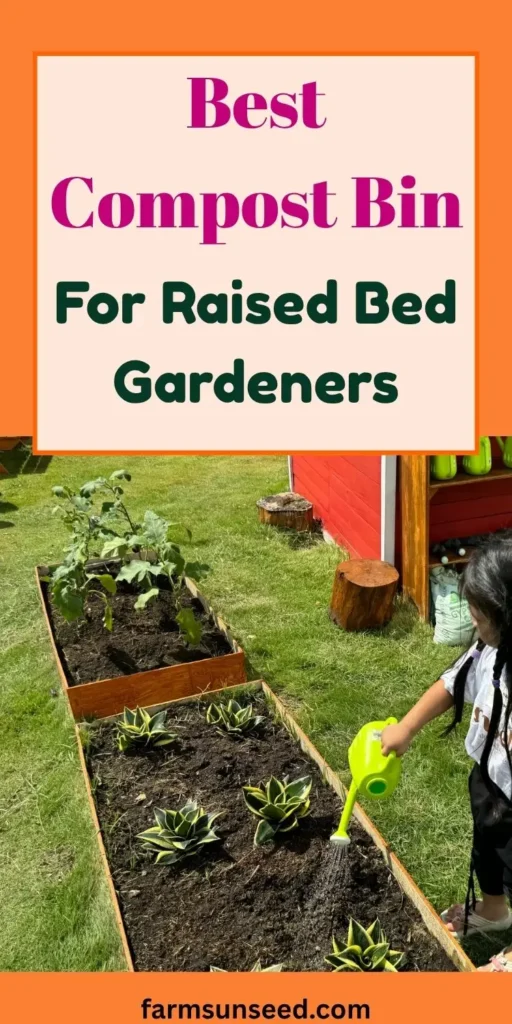
Best Compost Bin For Raised Bed Gardeners
Why Standard Compost Bins Fail the Raised Bed Gardener?

Take a look at your current bin. If it’s a small plastic box with a hatch at the bottom, I can guess your problem. The stuff at the top is fresh. The stuff at the bottom is sludge. And you never have enough “black gold” for the beds.
The volume gap is real. Raised beds need top-dressing two or three times per year. A basic slatted bin cannot turn waste into mature compost that fast.
A 2024-2026 study from the FAO and University of Illinois found that compost-only raised beds had 20 times higher water infiltration than regular soil. That sounds good, but it actually means you have to water more often. The water just runs through.
The same study found something important. Compost beds reduced weeds by 93 to 97 percent. But that only works if the compost is fully broken down. Incomplete compost grows weeds. It also steals nitrogen from your plants instead of feeding them.
*A 4×8 raised bed needs about 8 cubic feet of compost just for a 2-inch top dressing. That is roughly five store-bought bags.*
A bin that gets hot. Heat means faster breakdown. Heat kills weed seeds. Heat gives you compost in weeks instead of years.
Key takeaway: Your soil is starving. A cold, slow bin will not save it.
2026 Tested & Reviewed: Top Picks For Bed Gardeners
Here is the 2026 shortlist. These are tested by real buyers and garden experts.
Speed Demon: The HOTBIN Mk. 2

This bin reaches temperatures between 40 and 60 degrees Celsius. It makes compost in 30 to 90 days. Gardeners’ World voted it a “Best Buy” in their tests.
- What is good: It works all year round. No turning required. Has a temperature gauge in the lid.
- What you should know: You need to pre-mix waste with paper and wood chips. You must add at least 5kg of waste per week to keep it hot.
- Best for: Gardeners who need compost right now.
The Set-It-and-Forget-It: Green Johanna

This Swedish-designed bin holds 330 litres. It is made from 100 percent recycled plastic. It does not need pre-mixing like the HOTBIN.
- What is good: Accepts cooked food, meat, and fish. Has a five-year warranty. Expected to last over 10 years. The base plate has 4.5mm holes that let worms in but keep rodents out.
- What is annoying: The winter jacket for cold weather is sold separately. The plastic aerator stick is hard to use.
- Time to first batch: 6 to 8 months in year one, 4 to 6 months after that.
The Tumbler: VEVOR 53 Gallon Dual Chamber

This one is popular for a reason. The dual chambers let you fill one side while the other side cures. The manufacturer says it makes compost in 4 to 6 weeks.
- What is good: Large capacity. Hand crank for easy turning. Built-in air vents.
- Here is the catch. A February 2026 review on the VEVOR site says the gear slipped when the bin had a small amount of weight. The reviewer added five gallons of dirt and some vegetable peels. The gear slipped, and the drum started spinning freely. The reviewer said: “I feel like I’ve wasted my hard-earned money”.
- Other buyers had better luck. One said the price and features are the best they could find.
Which one wins? If you grow tomatoes or other heavy feeders, get the HOTBIN for speed. If you grow herbs and want an easy bin, get the Green Johanna.
Key takeaway: Avoid VEVOR if you are filling it heavily. The gear might slip.
Direct Integration: Composting Inside The Raised Bed

Why walk the compost to the bed when the worms can do it for you?
The 2026 trend is in-bed composting. Instead of a bin next to your bed, you put the bin inside the bed.
Subpod and Worm Cafe systems work like this. You bury a small bin in your raised bed. Worms live in it. They eat your scraps. Then they travel from the bin directly into your soil. Their movement aerates the soil for free.
The Hügelkultur method is another option. Fill the bottom third of a new deep bed with logs and branches. As they break down, they release nutrients slowly for years. This is mentioned in 2026 DIY gardening forums as a low-cost alternative to buying a bin.
The same FAO study found that mixing soil with compost reduced irrigation demand by 32 percent in the second year. Pure compost beds needed more water. The mix held moisture better.
Key takeaway: An in-bed worm bin turns waste into worm castings right where your plants need them.
Compost Math: Sizing Your Bin To Your Bed Footprint

Most gardeners buy bins that are too small. Let us fix that with actual numbers.
Here is the formula.
A 4×8 bed at 2 inches deep needs 5.3 cubic feet of compost per season. That is about five 1-cubic-foot bags.
A standard 220L Blackwall bin holds about 7.7 cubic feet. But it only produces usable compost twice per year. That is not enough.
You need a bin of at least 300 litres to keep a single 4×8 bed fully fed. The Nature Thermo Silo holds 800 litres and costs about 189 euros. It is fully collapsible for storage.
If you have three beds, here is the number. At 3 inches deep, a 4×8 bed needs 0.3 cubic yards or about five 2-cubic-foot bags. Three beds need 0.9 cubic yards. That is roughly 1,200 litres of compost per season.
A tip from Farmer Grows: Always add 10 percent extra. Compost settles over time.
Key takeaway: Add up your total bed square footage. Multiply by 0.15 for depth in feet. Buy a bin that matches that volume. Then double it.
The 2026 Strategy: Why You Need Two Bins
You cannot make continuous compost with one bin. Here is the system that works.
Bin 1 is the Cooker. This is your HOTBIN or insulated tumbler. All kitchen scraps go here right now. It breaks down fast and hot.
Bin 2 is the Riper. This is a simple pallet bin or an open plastic bin. You can build one using five free pallets in an “E” shape, as shown by the Stamford Climate Action Group. After four to six weeks, the hot compost is no longer hot. Move it to Bin 2 to finish aging.
The actionable tip. While Bin 2 sits and cures, you start a fresh batch in Bin 1. This gives you a steady flow of finished compost every two months instead of twice a year.
What to avoid composting: Meat, dairy, oils, avocado skins, and eggshells take too long to break down. Cooked food attracts rats.
Key takeaway: Two bins double your output without doubling your work.
Quick Reference: How Much Compost Do You Need?
| Raised Bed Size | Depth | Cubic Feet | 1-cu-ft Bags |
|---|---|---|---|
| 4×4 feet | 2 inches | 2.7 | 3 bags |
| 4×8 feet | 2 inches | 5.3 | 6 bags |
| 4×8 feet | 3 inches | 8.0 | 8 bags |
| 4×12 feet | 3 inches | 12.0 | 12 bags |
Sources Used
- FAO/Agris: Raised Beds for Vegetable Production in Urban Agriculture (2024-2026)
- EvenGreener: HOTBIN Benefits and Gardeners’ World Test Results
- Farmer Grows: Compost Calculator and Coverage Charts (March 2026)
- VEVOR Customer Reviews: 53 Gallon Dual Chamber Tumbler (February-March 2026)
- Compost Magazine: Green Johanna Review (March 2026)
- Galaxus: Nature Thermo Compost Silo 800L (2026)
- LincsOnline: Stamford Climate Action Group Pallet Bin Method (February 2026)