Most people know composting is good for the planet. But most people also have no idea where to start.
You’ve probably searched for it before. You found something about “browns and greens,” felt confused, and closed the tab. Maybe you bought a bin that’s still sitting in a corner. Or maybe you’ve been meaning to start for two years and just never did.
That’s a very common place to be. And here’s the problem: most composting guides are written for people who already know what they’re doing.
This one isn’t.
Right now, only 5% of food waste in the U.S. gets composted. Food is the single largest thing filling up landfills, making up 24.1% of all municipal solid waste. The average family spends $1,500 a year on food they never eat. Most of it goes straight to the trash.
Composting won’t fix all of that. But it will fix your part of it.
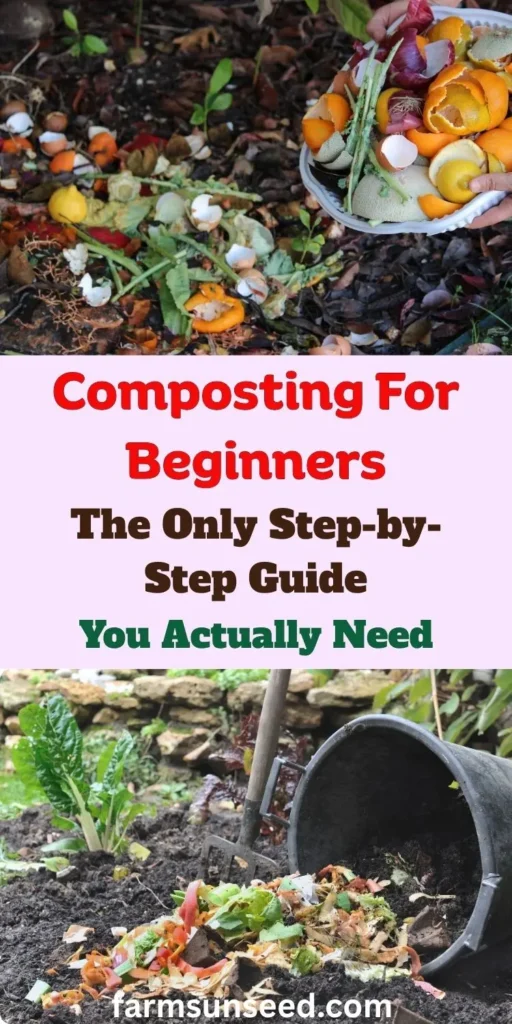
Composting For Beginners: The Only Step-by-Step Guide You Actually Need
What Is Composting and Why Does It Actually Matter?

🌱 COMPOST
scraps + leaves → dark soil
📊 +140% soil health (26 years later)
🌿 permanent upgrade to your dirt.
✅ Composting cuts methane 50%/ton
🚗 1 ton composted = car off road 1 month
📋 QUICK FACTS
Composting is nature’s recycling. You collect food scraps and yard waste, pile them up, and let microorganisms break them down into something called finished compost. It looks like dark, crumbly soil and smells like fresh earth after rain.
That finished compost does serious work in your garden. Compost can hold up to five times its own weight in water, which means your soil stays moist longer and needs less watering. It feeds plants slowly over months, so you need less fertilizer.
And according to a long-term study published in the Agronomy Journal, a single compost application raised soil health indicators by over 140% compared to untreated soil, and those benefits were still showing up 26 years later. That’s not a quick fix. That’s a permanent upgrade to your dirt.
Now here’s the environmental side. When food waste goes to a landfill, it breaks down without oxygen. That process releases methane, a gas that is 25 times more potent than car exhaust at trapping heat in the atmosphere.
Composting reduces methane emissions by 50% per ton of material processed compared to landfilling. Composting one ton of food scraps prevents about 0.25 tons of carbon dioxide equivalent from entering the atmosphere. That’s the same as taking a car off the road for a month.
And there’s a bonus that most people overlook. Household composting can cut the amount of waste going to your curb by 30%. Less trash. Less pickup. Less cost to municipalities.
Choose Your Composting Method Before You Buy Anything
Here’s the biggest mistake beginners make. They buy a bin, toss in some apple peels, forget about it for a month, and wonder why nothing is happening. The problem isn’t effort. It’s picking the wrong method for how they actually live.
There are three main ways to compost at home. Each one fits a different type of person. Read all three, pick one, and commit to it.
Option 1: The Open Pile

This is the most traditional method, and it’s almost free. You find a corner of your yard, start layering materials, and let nature do its work. No bin required, though you can build a simple enclosure with chicken wire or pallets.
Open piles are the most forgiving method. You don’t have to be precise. You don’t have to tend them constantly. The downside is time. Depending on how often you turn the pile and what you add, an open pile can take anywhere from 3 months to 2 years to produce finished compost.
Best for: People with outdoor space who want the lowest maintenance option.
Option 2: The Compost Tumbler Or Enclosed Bin

This is the most popular choice for suburban households. A tumbler is a sealed drum that you spin every few days to add oxygen. Enclosed bins are similar, but you use a tool to turn the material inside.
The payoff is speed. With regular turning, a tumbler produces finished compost in 4 to 6 weeks. It also keeps pests out and contains any smell.
Cost runs between $60 and $200 for a quality tumbler.
Option 3: Vermicomposting (Worm Bin)

This one sounds more complicated than it is. You get a bin, add bedding, and let red wiggler worms eat your food scraps. They produce something called worm castings, which is arguably the richest natural fertilizer you can put on a plant.
A worm bin is odorless when maintained correctly. It fits under a kitchen sink or on a balcony. It works in apartments. And it produces finished castings in about 3 to 4 months. Red wiggler worms are available online or at most pet stores.
Not Sure Which To Pick? Answer These Three Questions
- Do you have outdoor space? Yes, go with a pile or tumbler. No, go with a worm bin.
- Do you want results in under two months? Yes, choose a tumbler. No, an open pile works fine.
- Do you have zero time for maintenance? Go with the open pile. It’s the most forgiving.
Pick one. Start there. You can always upgrade later.
What To Put In Your Compost Bin (And What To Keep Out)

Here’s the one rule that covers most decisions: if it came from a plant, it probably belongs in your pile. Everything else comes down to the Browns vs. Greens balance. Browns are carbon-rich materials. Greens are nitrogen-rich materials. Your pile needs both to break down properly. A simple ratio to remember: two parts brown for every one part green, by volume.
Browns (carbon-rich, dry materials)

- Dry leaves
- Torn up cardboard (remove tape and labels)
- Shredded newspaper
- Paper bags
- Straw
- Wood chips
- Sawdust (untreated wood only)
- Paper towels and paper egg cartons
Greens (nitrogen-rich, wet materials)

- Fruit and vegetable scraps
- Coffee grounds
- Tea bags (remove any staples)
- Fresh grass clippings
- Plant trimmings
- Eggshells
Never Add These To Regular Compost Pile
- Meat, fish, or bones. They rot badly, smell worse, and attract raccoons, rats, and other pests. They also take much longer to break down, slowing your whole pile down.
- Pet droppings. They carry bacteria and parasites that can survive the composting process.
- Dairy products. Same problem as meat. Pests love it, your neighbors won’t.
- Oily or greasy food. Coats materials and prevents proper breakdown.
- Diseased plants. You risk spreading the disease when you use the finished compost.
- Treated wood or sawdust. Chemical residue can carry through into your soil.
The Gray Areas That Confuse Most Beginners
Citrus peels are fine in a regular outdoor pile or bin. Add them in moderation, and they break down without issue. But skip them if you’re using a worm bin. The acidity can harm your worms.
Eggshells are fine to add. They contribute calcium and take a while to fully break down, but they don’t cause any problems. Crush them first to speed things up.
Herbicide-treated grass clippings are a real concern. Some herbicides survive the composting process and can damage garden plants when you use the finished compost. If you’re not sure whether your lawn was treated, leave the clippings out or ask whoever treats it. When in doubt about anything else, bury it deep under a layer of browns. The pile will usually handle it.
How To Build Your First Compost Pile In 5 Steps
Here’s the only setup you actually need. Follow these steps once, and maintaining it becomes nearly automatic.
Step 1: Pick Your Location

Choose a spot with partial shade and good drainage. Full sun dries the pile out too fast. Full shade slows decomposition. Partial shade is the sweet spot.
Keep it away from fences, walls, and buildings. Leave room to walk around it and turn it. And pick a spot that’s easy to reach from your kitchen, because convenience matters more than you’d think.
Step 2: Get The Size Right

Your pile needs to be at least 3 feet wide, 3 feet long, and 3 feet tall. That’s the minimum size that generates enough heat to break things down properly and stay warm through cooler weather. Don’t go bigger than 5 cubic feet, or it becomes hard to turn and manage.
You don’t need to build this all at once. Your pile will grow over time as you add materials.
Step 3: Build Your First Layers

Start with a 2 to 3-inch layer of coarse material at the very bottom. Sticks, wood chips, or corn stalks all work. This creates airflow from underneath.
Then add alternating layers of browns and greens. Aim for two brown layers for every green layer. Chop or tear materials into smaller pieces before adding them. Smaller pieces break down faster.
Step 4: Check Your Moisture

Your pile should feel like a wrung-out sponge. Damp but not soaking. If you squeeze a handful and water runs out, your pile is too wet. Add dry browns like shredded cardboard or dry leaves. If the pile feels dusty and dry, give it a slow soak with a hose.
Check the moisture every time you add new material. It’s the single biggest factor in how fast your pile breaks down.
Step 5: Turn It Regularly

Turning your pile adds oxygen, which is what the microorganisms inside need to keep working. For beginners, turning once a month is enough to keep things moving. If you want finished compost faster, turn it every two to three weeks.
Signs your pile is working: it heats up in the center, steam rises when you open it on a cold morning, the volume shrinks, and earthworms start showing up. Once you’ve done this once, it takes about 5 minutes a week to maintain.
Why Is My Compost Not Working? 5 Common Problems Fixed
Your first pile will probably have at least one problem. That’s fine. Every beginner deals with this. Here’s how to fix the most common issues fast.
Problem 1: It Smells Bad

Cause: Too many greens and not enough air.
Fix: Add a thick layer of dry browns. Turn the pile to add oxygen. The smell should clear up within a few days.
Problem 2: Nothing Is Heating Up

Cause: The pile is too dry, too small, or doesn’t have enough green material.
Fix: Add water until it feels like a damp sponge. Add fresh grass clippings or vegetable scraps to boost nitrogen. Make sure your pile is at least 3 cubic feet.
Problem 3: Pests Are Getting In

Cause: Meat, dairy, or oily food was added. Or food scraps were left on the surface.
Fix: Remove any problem materials if possible. Always bury food scraps under at least a few inches of browns. Consider switching to an enclosed tumbler or bin with a lid.
Problem 4: It’s Taking Forever

Cause: Cold weather, pile too small, or not enough turning.
Fix: Insulate your pile by covering it with a tarp or adding a thick layer of straw around the outside. Add more material to increase the size. Turn it more often to speed up decomposition.
Problem 5: The Pile Is Soggy And Clumped Together

Cause: Too much rain or too many wet materials at once.
Fix: Add large amounts of dry browns. Tear up cardboard and layer it in. Cover the pile loosely with a tarp during heavy rain to prevent waterlogging.
Composting is genuinely hard to kill permanently. Even a pile that’s been sitting untouched for two years can be revived with turning, moisture, and fresh material.
How To Know Your Compost Is Ready (And What To Do With It)

Finished compost looks, smells, and feels nothing like what you put in.
Use all three senses to check:
Look: It’s dark brown to black. The texture is crumbly and uniform. You can’t identify any of the original materials. No chunks of eggshell or paper.
Smell: Fresh earth after rain. That’s it. If it still smells like food or ammonia, it needs more time.
Feel: Loose and crumbly. It breaks apart easily in your hand. No sliminess. No heat when you stick your hand into the center.
How Long Does It Take?
Open pile: 3 to 12 months, depending on how often you turn it. Tumbler: 4 to 8 weeks with regular turning. Worm bin: 3 to 4 months for finished castings.
When you think it might be ready, stop adding new material and let it sit for two to three weeks. This lets everything finish breaking down evenly.
How to Use Your Finished Compost

As a soil amendment, mix 2 to 4 inches of compost into the top 6 to 9 inches of soil before planting. This is best done at the start of a growing season.
As a mulch, loosen the top 2 to 3 inches of soil and spread a 3-inch layer of compost across the surface. Keep it a few inches away from plant stems and tree trunks to prevent rot.
You can also add it to flower and vegetable beds, mix it into potting soil for container plants, spread it across your lawn, or work it into tree beds.
That crumbly, dark handful you’ve been building for months? That’s one of the most valuable things you can put in your garden. And you made it for free.
Composting Without a Yard: How To Do It In a Small Space
No yard? No problem.
Most composting guides assume you have a big backyard. You don’t need one. Millions of people compost in apartments, on balconies, and in small rentals. Here’s how.
Worm Bins For Indoor Composting

A worm bin is the most practical indoor option. It fits under a sink, in a closet, or on a covered balcony. It doesn’t smell when maintained correctly. Red wiggler worms do the work. You feed them food scraps every few days and harvest the castings every few months.
Two-tray worm bins are the easiest to manage. When the bottom tray fills up, the worms migrate upward, and you harvest from the bottom. Simple and clean.
Countertop Collectors

Even if you’re not composting at home, you can collect scraps and drop them off. Stainless steel countertop bins with odor filters are available for under $30. You fill them up, seal the lid, and bring them to a local drop-off point.
Many cities now offer food scrap drop-off sites at farmers’ markets, community gardens, and transfer stations. Some areas have curbside collection for food scraps. A growing number of cities now offer private pick-up services specifically for apartment buildings.
Find Your Local Options
The EPA’s home composting page at epa.gov/recycle/composting-home has a drop-off locator where you can search by zip code.
Even if all you do is collect your scraps in a countertop bin and drop them off once a week, you’re composting. That still counts. That still keeps food out of a landfill.
Start there. It’s enough.
Start Today. One Bag of Leaves Is All You Need.
Composting is one of the most practical habits you can build at home. It costs almost nothing. It takes about 5 minutes a week once you’re set up. And it turns the stuff you’d normally throw away into something genuinely useful.
The hardest part is making the first pile.
So do it today. Look in your kitchen right now. Coffee grounds from this morning. Vegetable peels from last night. A paper bag from the grocery store. That’s your first green layer and your first brown.
Go outside and grab some dry leaves or tear up a cardboard box. Layer it on top.
You’ve started.
Composting for beginners doesn’t have to be complicated. It just has to begin.