
Then I stepped inside. The smell of mildew hit me first, followed by the owner’s apologetic smile. The condensation issue isn’t something we expected, she admitted, pointing to the damp corners where the wall meets the ceiling. This moment crystallized the gap between tiny home fantasy and reality. For every sunlit, clutter-free tiny house on your social feed, an owner is dealing with challenges the carefully angled photos never reveal.
Over the past year, I’ve visited 50 tiny homes across North America, from sleek urban models to rustic off-grid cabins. I’ve shared meals at fold-down tables, slept in lofts requiring gymnastic skills to access, and heard unfiltered stories from people living the tiny life day after day.
What I discovered wasn’t a rejection of tiny living, but rather a more nuanced reality than what TV shows and social media portray. The tiny home movement offers genuine benefits, but it also presents unique challenges that prospective owners should understand.
I Visited 50 Tiny Homes – Here’s What They’re Not Showing You

1. The True Cost of Tiny Home Ownership in 2025

The price tag on tiny homes might seem like a steal at first glance. When I began touring tiny homes, owners kept telling me the same story: what started as a $45,000 budget quickly ballooned beyond recognition.
I thought I was getting a complete home for $40,000, “Megan, a tiny homeowner in Oregon, told me. Two years and $75,000 later, I’m finally finished.
The hidden costs add up quickly:
Land purchase or rental ($5,000-$25,000 per acre or $250-$1,500 monthly for RV spots)
Permitting fees ($500-$3,000 depending on location)
Utility hookups or off-grid systems ($5,000-$15,000)
Site preparation and foundation work ($4,000-$10,000)
Customizations and upgrades that become essential once you start living small
Even after move-in day, your wallet isn’t safe. Expect annual maintenance expenses between $300-$1,000, depending on your climate and building materials.
Perhaps most surprising is what happens when you decide to sell. Unlike traditional homes, most tiny houses depreciate like RVs rather than appreciate like real estate.
Standing in a beautifully crafted 275-square-foot home in Colorado, I couldn’t help but wonder: Is the freedom worth the financial reality?
The answer depends entirely on your priorities and your eyes being wide open before you begin.
2. The Zoning and Legal Battles You’ll Face

I spent more time fighting city hall than building my tiny home, Jason told me, standing in his 320-square-foot house that took three years to legally place on his own land in Michigan. His story isn’t unique.
The legal landscape for tiny homes is a bewildering maze that changes with every county line you cross. Forget state laws; it’s local regulations that make or break your tiny dream.
States like California, Maine, and Texas have become more welcoming to tiny homes (especially Austin and Spur), while others like Alaska, Iowa, Louisiana, and New York have regulations that make tiny living difficult or outright illegal in many areas. But here’s the catch: even in friendly states, individual counties and cities create their own rules.

Your tiny home’s legal classification is a critical fork in the road:
On foundations: Treated as a permanent structure subject to building codes
On wheels: Often classified as an RV with restrictions on permanent living
The biggest hurdle? Minimum square footage requirements. Many local governments mandate homes be 700-1,000 square feet, far larger than most tiny homes, making it impossible for them to qualify as legal permanent residences.
During my visits, I’ve seen creative workarounds. Some owners register their homes as accessory dwelling units on properties with existing houses. Others join tiny home communities specifically zoned for small dwellings.
Before buying anything, visit your local planning department in person, advised Sophia, who successfully navigated Denver’s regulations. The website might say ‘no,’ but face-to-face conversations can reveal exceptions.
Watching tiny homeowners spread building plans across tables in permit offices has become a familiar sight in my travels.
The most successful owners don’t fight the system; they find the path of least resistance through it. This might mean choosing your location based on laws rather than scenery. Is the compromise worth it? That depends on how badly you want to go tiny.
3. The Space Reality: What Daily Living Actually Looks Like

I’ll never forget watching Mark try to prepare dinner in his 180-square-foot home, while his wife was working from their fold-down table just three feet away. Every movement required coordination. It’s like a choreographed dance, he laughed. We had to learn each other’s patterns or we’d constantly collide.
This is the daily reality: beautiful in theory, complicated in practice.
Privacy becomes a luxury item in these spaces. Jenny Comperda, who’s lived in her 280-square-foot home since 2018, shared that private phone calls are nearly impossible, and bathroom privacy? Forget about it. Several couples I interviewed admitted they now poop in front of each other, a level of intimacy few consider before moving in.

Where does all your stuff go? That’s the question everyone asks. The answer: you have far less than you think you need. Every tiny homeowner I met had a letting-go story.
I donated 80% of my possessions, said Tara in her Austin tiny home. Now, everything I own serves multiple purposes or brings genuine joy.
Daily activities require creative adaptation:
Working from home means your office disappears at dinner time
Exercise often moves outdoors or requires furniture rearrangement

Hobbies with equipment become challenging (goodbye, drum kit)
Entertaining guests? That often means outdoor space or public venues
Success in these spaces demands meticulous organization. Without careful planning and systems, these homes quickly become dysfunctional and claustrophobic.
Walking through dozens of tiny homes, I noticed the happiest residents weren’t those with the most clever storage solutions they were those who’d embraced owning less.
The question isn’t whether you can fit your life into 300 square feet. It’s whether you’re willing to reshape your life to match the space.
4. Location Challenges: The Reality of Finding a Place to Park

The irony hit me during my fifth tiny home visit: these supposedly mobile homes often have nowhere to go. The freedom of wheels beneath your home can quickly become an illusion when faced with the question: But where can I legally put it?
I’ve moved four times in three years, sighed Elena, whose 220-square-foot home was parked on her cousin’s rural property in Washington. Finding a permanent spot feels harder than building the house was.
Your location options generally fall into four categories, each with significant trade-offs:
Private land: Ideal, but requires navigating zoning laws
Backyard placement: Depends on local ADU (Accessory Dwelling Unit) regulations

RV parks: Legal but often have stay limitations and community rules
Tiny home communities: Growing but with limited availability, and often waitlisted
If you don’t own land, prepare for ongoing costs. RV or campground lot rentals typically run $250-$1,500 monthly, depending on included utilities, with some parks offering long-term stay discounts.
The nomadic reality is common. Jenny Comperda has relocated her tiny home multiple times for work, living variously on a vineyard, in a friend’s yard, an RV park, and currently rents a spot on a lavender farm in California.

Urban placement brings conveniences but stricter regulations. Many cities restrict tiny homes on wheels to specific R-5 zones, while foundation-based homes face fewer location restrictions but require conditional use permits and must meet building codes.
In my travels, the happiest tiny homeowners weren’t necessarily those with the prettiest homes, but those who had secured stable, legal parking.
The most promising development? Purpose-built tiny home communities offering permanent lots with utility hookups, shared amenities, and legal protection. Though still limited, these communities represent the future of sustainable tiny living if you can get off their waiting lists.
5. Utility Challenges: Power, Water, and Waste Management

Solar panels glistening on tiny roofs. It doesn’t show me hauling water in freezing temperatures, remarked David, whose Colorado tiny home sits on a beautiful but utility-challenged mountain plot.
The fantasy of unplugging from the grid faces a stark reality check when you’re actually living it. After visiting dozens of homes, I’ve seen the full spectrum from primitive setups to sophisticated systems that rival conventional houses.
Connecting to utilities poses significant challenges for tiny dwellers, particularly those in rural or off-grid locations. Your options essentially break down to:
Grid connection: Simplest but requires permitted land with existing infrastructure

Partial off-grid: Grid electricity with alternative water/waste solutions
Fully off-grid: Complete independence with higher complexity and maintenance
Water becomes your most immediate concern. Most off-grid homes I visited used a combination of rainwater collection, water deliveries, and conservation fixtures. Showers are shorter. Laundry often happens elsewhere.
Waste management reveals the least glamorous reality. Composting toilets dominate the off-grid scene, requiring regular maintenance and emptying. You get used to it, every owner tells me. The learning curve is real.
Power limitations change daily habits. Modern tiny homes increasingly integrate solar panels with battery storage systems like Tesla’s Powerwall for energy independence, though these can add $15,000+ to initial costs.

Utility expenses run lower than traditional homes; they vary significantly based on usage patterns and location. The most successful setups I’ve seen involve redundant solar systems with generator backup, multiple water sources, and contingency plans for everything.
I’ve noticed the tiny homeowners who thrive with utilities are those who embrace these challenges as part of the lifestyle rather than fighting against them.
The question isn’t whether you can manage these systems, but whether you want utility management to become a significant part of your daily life.
6. The Weather Challenge: Climate Adaptations for Tiny Homes

The romance of rainy days in a tiny home fades quickly when condensation drips from your ceiling onto your pillow. Weather isn’t just something you experience in tiny homes; it’s something you battle.
My first winter taught me that tiny homes amplify weather, not buffer it, explained Natalie, whose Vermont tiny home has survived three harsh winters. “Every temperature shift feels more extreme in a small space.
This amplification effect creates unique challenges:

Temperature swings happen fast; a tiny space heats up and cools down rapidly
Condensation forms easily without proper ventilation
Wind impact is greater than in larger, heavier structures
Weather noise is amplified through thinner walls and roofs
Insulation becomes your first line of defense. For winter living, experts recommend minimum R-values of R-20 for walls and floors and R-40 or higher for roof insulation, plus protective skirting around the base to block cold air infiltration.

The most weather-resilient tiny homes I’ve toured use a combination of strategies. Modern designs increasingly incorporate strategic natural light and ventilation systems to reduce dependency on artificial heating and cooling.
Moisture management requires particular attention. Dehumidifiers are standard equipment in most climates, and proper ventilation, especially in bathrooms and kitchens, proves essential.
One clever owner in Colorado showed me how he adapts seasonally: I built movable insulation panels for my windows, reflective side out in summer, absorptive side out in winter.
Extreme weather testing is common among serious owners. One tiny homeowner deliberately spent a night in his home during a major snowstorm, using both indoor heating and an outdoor fire to verify its cold-weather performance.
Standing in a tiny home during a thunderstorm in Tennessee, I was struck by how the rain on the metal roof wasn’t just heard, it was felt.
7. The Solutions: What Actually Works in Tiny Living

After 50 tiny homes, I’ve seen countless Pinterest-inspired solutions that look great but fail in practice. But I’ve also discovered genuine innovations that transform tiny living from a compromise to a preference.
The difference? Successful solutions address real daily needs rather than hypothetical ones.
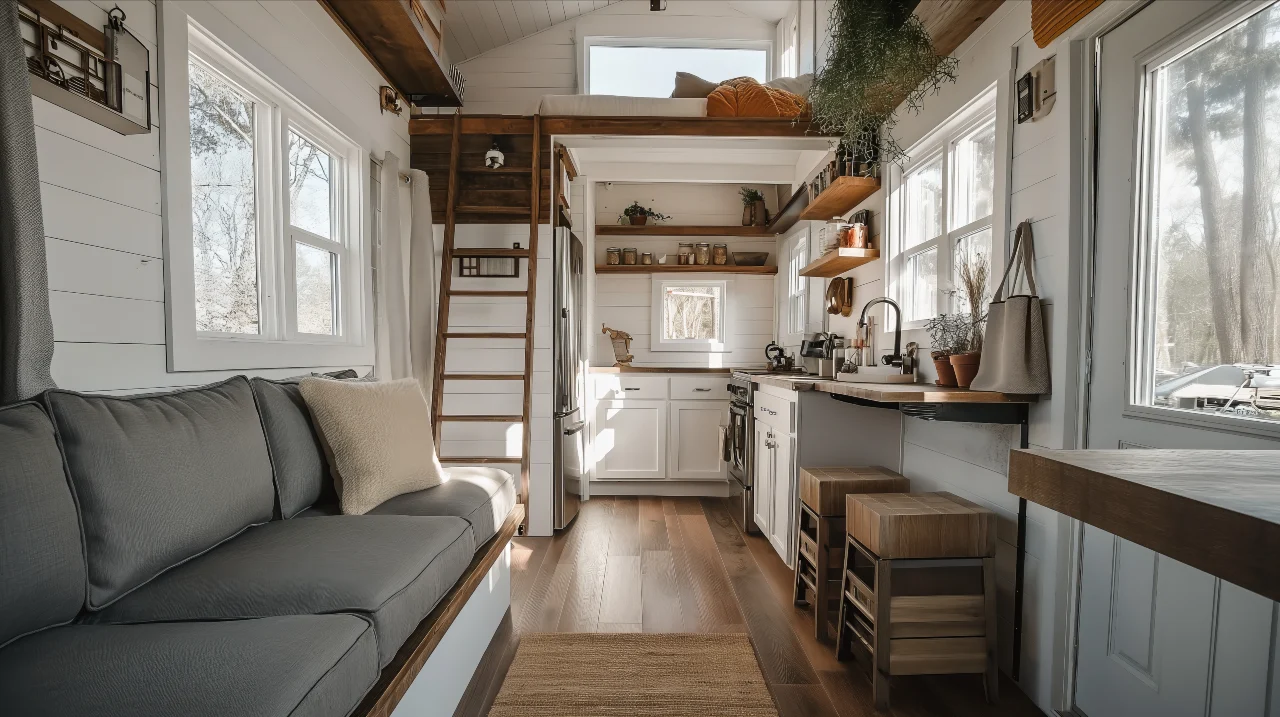
The most functional homes consistently feature thoughtful multi-purpose furniture and vertical living strategies. Lofted sleeping areas free up floor space below, while built-in storage eliminates wasted space in walls and under staircases.

What’s worth the investment? Four things repeatedly prove their value:
Quality convertible furniture that smoothly transforms without frustration
Custom-built storage solutions tailored to your specific belongings
High-end thermal windows that regulate temperature and reduce condensation
Robust ventilation systems that manage moisture and air quality

The aesthetics matter more than you might think. Homes like the Zen model succeed by using clean lines and simple color schemes to create a sense of calm and spaciousness despite limited square footage. Visual simplicity translates to psychological spaciousness.
Ingenious space-savers earn their keep. I’ve seen kitchens with folding faucets, sinks hidden beneath countertops, and cutting boards that double as sink covers to create seamless work surfaces.
What struck me most wasn’t the clever tricks but the mindset shift. The happiest tiny dwellers don’t just adapt their homes, they adapt their expectations.
Beyond individual homes, community solutions make the biggest difference. Shared workshops, guest accommodations, and storage facilities eliminate the need for these spaces in each home. The most successful tiny home settlements I’ve visited offer community gardens, shared tools, and communal gathering spaces.
The true innovation in tiny living isn’t just in the homes themselves, it’s in reimagining what home means beyond four walls.
