
For most of adult life, “What do you do?” is an easy question. Then retirement arrives, the job title disappears, and a harmless conversation starter can suddenly sound more like, “Who are you now that you no longer have that job?”
That discomfort is not necessarily about missing work. Employment may have provided identity, routine, people, responsibility, recognition, and a reason to be somewhere at 9 a.m.
Recent research on purpose in older Americans suggests that social engagement, self-esteem, perceived control, and other resources can matter alongside simply staying occupied.
Why “What Do You Do?” Can Feel So Different After Retirement

A person can spend 35 or 40 years building a professional identity without consciously deciding to do it. “I’m a teacher” slowly becomes different from “I teach for a living.”
That distinction becomes obvious only when the job ends.
AARP has highlighted this issue in its reporting on the emotional transition into retirement. Careers can become a core part of how people introduce themselves and how other people recognize them.
A qualitative study of people who had recently retired also identified changes in time structure, meaningful activities, roles, identity, and emotional adjustment as significant parts of the retirement experience.
Before looking at the 13 answers, it helps to identify what the job may actually have been supplying. A retiree does not necessarily need another job, but some of those missing pieces may need another home.
| What Work May Have Provided | What Can Replace It | Example |
|---|---|---|
| Daily structure | Chosen routines | Morning walk, class, regular project |
| Social contact | Community | Club, volunteering, friends |
| Contribution | Useful roles | Mentoring, caregiving, service |
| Progress | Learning or projects | Language, woodworking, gardening |
| Identity | Broader self-description | Parent, volunteer, artist, traveler |
| Recognition | Personal mastery | Fitness goal, teaching, creating |
The goal is not to recreate the office in retirement. It is to notice which parts of working life you actually miss and replace only the ones worth keeping.
That difference explains why one retiree may happily spend Tuesday gardening while another feels restless doing exactly the same thing.
1. “I’m Retired, and I’m Enjoying Having Control of My Time”

One of the simplest answers is also one of the hardest for achievement-oriented people to accept. There may be nothing wrong with saying that your main activity right now is enjoying the freedom you spent decades working to obtain.
Retirement discussions include people who describe ordinary days filled with reading, exercise, meals, puzzles, housework, friends, and other activities without feeling the need to turn retirement into another career.
This answer can feel different because it changes the measurement of a successful day. The question stops being, “What did I produce?” and becomes, “Did I spend my time in a way I actually wanted?”
Freedom still benefits from some structure. But structure chosen by you feels very different from a calendar controlled by somebody else.
2. “I Volunteer a Few Hours a Week”

For some retirees, what they miss most is not the paycheck or even the profession. They miss being expected somewhere.
Volunteering can restore that feeling without bringing back a 40-hour schedule. AARP has profiled retirees who discovered renewed purpose through community service, while the National Institute on Aging notes that helping others through volunteering can provide connection and a sense of mission.
The important part is finding the right dose. A volunteer commitment can give Tuesday morning a purpose without taking over Monday through Friday.
It also does not need to match your former career. Someone who spent 35 years managing budgets may get more pleasure from helping at an animal shelter than sitting on another finance committee.
3. “I Work a Little, but Only Because I Want To”

Retirement does not have to mean never earning another dollar. Some retirees discover that they like work much more when they can control the hours, type of work, and ability to walk away.
Recent retiree discussions include people deliberately looking for part-time jobs that are interesting, social, or completely different from their former careers. Other retirees consult only a limited number of hours because they enjoy using their experience without returning to full-time employment.
That is a very different relationship with work. Work becomes one ingredient in life rather than the container holding the entire week.
The key distinction is choice. Someone working because they need income may experience this very differently from someone who is financially secure and chooses a small amount of paid work for structure or enjoyment.
The answer that feels best will often depend on what you actually miss. These are different problems, so they need different responses.
| If You Miss… | A Possible Answer to Build Around | First Experiment |
|---|---|---|
| People | “I’m active in…” | Attend one recurring group |
| Being useful | “I volunteer with…” | Try one service role |
| Challenge | “I’m learning…” | Take a short class |
| Professional work | “I still do a little…” | Test a small project |
| Structure | “My week usually includes…” | Fix two weekly commitments |
| Freedom | “I’m enjoying retirement” | Protect unscheduled time |
Notice that none of these requires a permanent decision. Retirement can be treated as a series of experiments instead of a test you must pass immediately.
That matters because an activity that looks perfect on paper may feel wrong after six weeks. You are allowed to replace it.
4. “I’m Learning Things I Never Had Time to Learn”

There is something powerful about becoming a beginner again when nobody is evaluating your performance.
Retirement discussions repeatedly mention language classes, cooking, sewing, quilting, sports, reading, music, and other forms of learning. In one discussion about career identity, a retiree described replacing professional prestige and responsibility with activities including classes, athletics, and cooking.
Research supports the broader idea that activity matters. A study using several waves of the U.S. Health and Retirement Study found that people reported a higher sense of purpose on occasions when they participated more in leisure activities, while more active participants showed less decline in purpose over time.
That does not mean you need to collect hobbies. One activity that gives you something to improve at may be enough.
5. “I Exercise, Read, Cook, and Have a Routine I Like”

This may sound less impressive than describing a senior executive position. It can still describe an excellent life.
Many retirees initially underestimate the value of ordinary structure. Work automatically divided life into mornings, lunch breaks, weekends, vacation days, and deadlines.
Remove the job and Wednesday can suddenly feel exactly like Sunday.
A routine restores shape to time. The National Institute on Aging encourages older adults to combine enjoyable activities, social engagement, hobbies, learning, and other meaningful pursuits rather than viewing healthy aging only through physical exercise.
A useful retirement routine does not need to be packed. Two or three anchors may be enough: exercise Monday morning, lunch with friends Wednesday, volunteering Friday.
The empty space between them is not a planning failure. That space may be one of the benefits of retirement.
6. “I Help My Family More, but I Still Have My Own Life”

Children, grandchildren, aging siblings, spouses, and friends can become a meaningful part of retirement. Helping people you love can provide connection and the satisfying feeling of being useful.
But there is a difference between choosing to help and becoming the person everyone assumes is permanently available because “you’re retired now.”
That boundary matters.
A retiree can proudly say that family is an important part of life while still keeping hobbies, friends, travel, exercise, or quiet time. Retirement does not turn a person’s calendar into communal property.
Purpose can involve mattering to other people, and research reviews on purpose in later life identify relationships and making a difference to others among its recurring dimensions.
The healthiest answer may therefore include family without allowing family to become the only answer.
7. “I’m Active in My Club, Neighborhood, Church, or Community”

Workplaces quietly create repeated contact. You see the same receptionist, coworker, customer, manager, security guard, or lunch group week after week.
Retirement can remove dozens of those small interactions overnight.
That is why social connection sometimes deserves deliberate planning. The National Institute on Aging notes that retirement can be one circumstance that leaves people unexpectedly more isolated, while meaningful activity with other people can support mood, purpose, and well-being.
You do not need 20 close friends. What many people need is somewhere they belong often enough to be noticed.
A club, recreation center, faith community, neighborhood group, library program, service organization, or regular breakfast group can provide that repeated contact.
Showing up again may matter more than finding the perfect organization.
8. “I Make Things Now”
A finished spreadsheet disappears into an office system. A repaired chair, quilt, garden bed, painting, photograph, meal, birdhouse, or piece of writing exists because you made it.
Creative activity can give retirement something work often provided: visible progress.
It also changes the answer from a former identity to a present activity. Instead of explaining what you did for 38 years, you get to talk about what you are working on this week.
This does not require artistic talent. Cooking counts. Restoring an old car counts. Building shelves counts. Writing family history counts.
The point is having something unfinished that makes you want to return tomorrow.
At this stage, it can help to check whether your retirement is replacing the resources you actually valued at work. Research on retirement adjustment suggests that areas such as social support, autonomy, self-esteem, health, and perceived resources can move alongside life satisfaction during the transition.
| Ask Yourself | Strong Sign | Possible Gap |
|---|---|---|
| Do I have reasons to leave the house? | Several each week | Days regularly blur together |
| Does anyone expect me somewhere? | Regular social commitments | Almost nobody notices my absence |
| Am I learning or improving? | One active challenge | Little sense of progress |
| Do I feel useful? | I contribute somewhere | I rarely feel needed |
| Can I control my time? | Mostly yes | Calendar feels crowded again |
| Do I enjoy ordinary days? | Usually | Only trips feel worthwhile |
You do not need to score perfectly in every row. Different people need very different amounts of structure, company, challenge, and responsibility.
The table is useful because it converts the vague question “Do I have enough purpose?” into smaller questions you can actually answer.
9. “I Travel, but Travel Isn’t My Whole Retirement”

Travel appears constantly in retirement plans for an obvious reason. Working adults often have more destinations than vacation days.
But even enthusiastic travelers eventually come home.
That makes travel a wonderful retirement activity but a shaky retirement identity by itself. A life that feels empty whenever there is no flight booked may still need stronger everyday foundations.
The same principle applies to golf, cruises, RV trips, fishing, or any other major leisure activity. Enjoy them without asking one interest to carry the emotional weight of an entire retirement.
A stronger answer might be, “We travel several times a year, and between trips I volunteer, exercise, see friends, and work on the house.”
That sounds less dramatic. It may describe a more sustainable week.
10. “I Take Care of My Home, Garden, and Everyday Life”
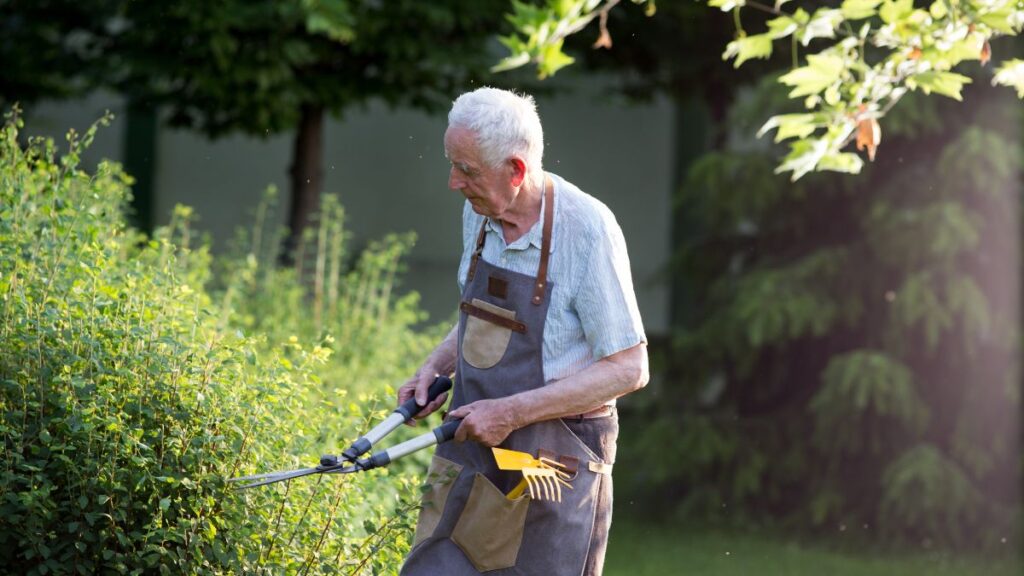
One reason people struggle with retirement answers is that American culture often treats paid activity as more legitimate than unpaid activity.
Yet running a household takes time. So does cooking well, maintaining a garden, caring for pets, exercising, seeing family, repairing things, managing appointments, and creating a pleasant home.
Retirement gives some people the chance to do these things without squeezing them into evenings and weekends.
There is no rule saying your new identity must impress someone at a cocktail party.
A person who enjoys an unrushed breakfast, works in the yard, reads for an hour, takes a long walk, cooks dinner, and sees friends may be living exactly the retirement they wanted.
The answer changed because the standard changed. Productivity stopped being the only way to prove that a day mattered.
11. “I Still Use My Old Skills, Just on My Terms”

Retirement identity does not need to involve rejecting everything that came before it.
Some people genuinely loved their profession. They simply stopped loving the schedule, politics, pressure, commute, deadlines, or lack of control.
Consulting, mentoring, tutoring, serving on a nonprofit board, helping younger professionals, or doing occasional project work can preserve the enjoyable part of an old identity.
Retirement discussions show that limited consulting can work for some people, although others discover through the experience that they are more ready to leave their old professional world than they expected.
That discovery has value too.
Retirement does not ask, “Are you still an engineer?” The better question might be, “Which parts of being an engineer are still worth keeping?”
Keep those. Leave the rest.
12. “I’m Retired. I Don’t Feel the Need to Justify It”
There is another perfectly legitimate answer: “I’m retired.”
No follow-up résumé is required.
Some retirees say the question bothers them because they feel pressure to demonstrate that they are still productive or interesting. Others have reached the point where they are comfortable stating their retirement status and letting the other person decide what to ask next.
This answer represents a different kind of identity change. Instead of replacing professional status with a new impressive activity, the retiree stops needing status to carry the conversation.
That may take time.
Someone newly retired after four decades in a respected profession might initially feel exposed without the title. Two years later, explaining the old job may feel strangely irrelevant.
13. “I’m Still Figuring That Out”

This may be the most useful answer for a brand-new retiree.
You are allowed to not know yet.
A recent retirement discussion from a 68-year-old newly retired woman described exactly this unsettled period.
After a demanding technology career, health issues, and an earlier-than-planned exit, she found herself confronting the question of what came next rather than immediately stepping into a polished new retirement identity.
That is not evidence of a failed retirement. Retirement adjustment is a process, and research has long treated the transition as adaptation to a new set of circumstances rather than an event that finishes on the final day of work.
Try things before adopting labels.
Volunteer for six weeks. Take one class. Join one club. Try the consulting assignment. Spend a month with fewer commitments. Start the garden.
Then notice which version of your week you want to keep.
