In 2026, the average household throws away $1,800 of food annually. Most of that waste could be “black gold” for your garden instead of trash. Many people want to start composting but stay on the sidelines. They worry about bad smells, attracting rats, or “ruining” the pile with the wrong scraps.
It does not have to be a guessing game. This guide gives you the Ultimate Yes/No Compost List with over 100 items. You will learn the simple logic of the Carbon to Nitrogen ratio and get the latest 2026 updates on “bioplastics” and smart sensors.
You might have a big backyard or a small apartment, but you will know exactly what to toss and what to skip. Stop guessing and start building better soil today.
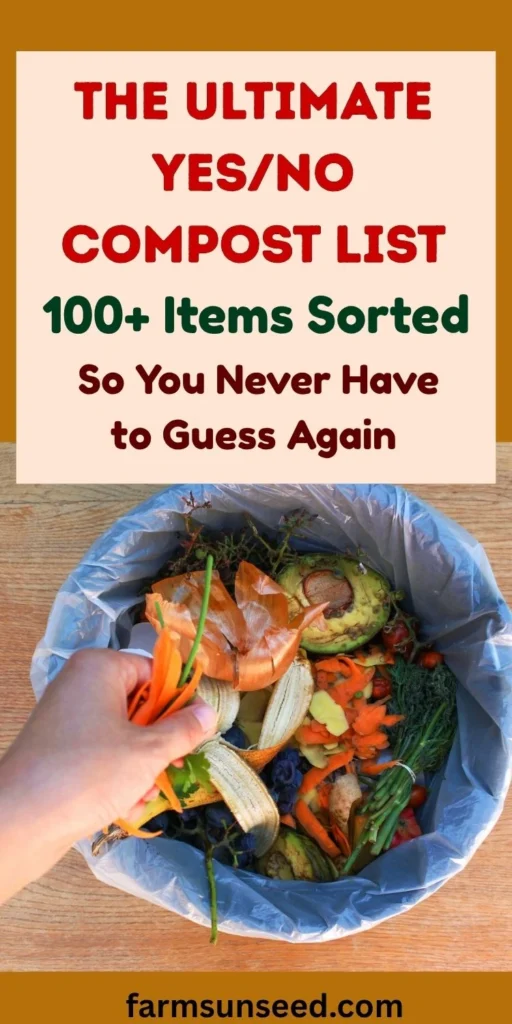
The Ultimate Yes/No Compost List: 100+ Items Sorted So You Never Have to Guess Again
The “Absolute No” List: 10 Items That Will Ruin Your Pile
Let’s get the dangerous stuff out of the way first. If you add these, you aren’t composting. You are creating toxic sludge.
Here is what happens when you mess this up. One wrong item attracts rats. Those rats dig up your garden. Then you have two problems instead of one. So pay attention to this list.
1. Meat and Dairy

NO
Raw chicken, spoiled milk, cheese rinds, beef fat. These cause pathogens like Salmonella and E. coli. Your home pile does not get hot enough to kill them. Plus, raccoons can smell meat from a quarter mile away.
Fix it: Freeze meat scraps and take them to a municipal green waste facility. Call your city first to confirm they accept it.
2. Produce Stickers

NO
Those little plastic stickers on apples and peppers? They are plastic. They do not break down. After six months in your pile, you will find them fully intact. They contaminate your finished compost.
Fix it: Peel them off immediately. Stick them to a piece of cardboard and toss that in the recycling bin. The recycling process filters them out.
3. Black Walnuts (Leaves, Shells, Hulls)

NO
Black walnut trees produce juglone. That is a natural herbicide. It kills tomatoes, peppers, and potatoes. Even after composting for a year, juglone stays active.
Fix it: Burn the shells for heat or make a walnut shell tincture. Do not put them anywhere near your vegetable garden.
4. Diseased Leaves (Rust, Black Spot)

NO
Rose leaves with a black spot. Oak leaves with rust. These diseases survive in compost. You will spread them next spring.
Fix it: Bag them for landfill pickup. Or burn them if your city allows outdoor burning.
5. Weeds That Have Gone To Seed

NO
One mature dandelion head has 150 seeds. Your pile will not kill them. You will plant weeds on purpose every time you spread that compost.
Fix it: Solarize the weeds. Put them in a black plastic bag in direct sunlight for six weeks. Then compost the dead material.
6. Pet Waste From Dogs And Cats

NO
Roundworm. Hookworm. E. coli. Parasites in dog and cat feces survive for over a year. If you use that compost on vegetables, you can get very sick. Herbivore pets like rabbits and guinea pigs are fine. Meat-eaters are not.
Fix it: Flush it (if your city allows) or bag it for trash. Never compost it.
7. Glossy Or Colored Paper

NO
Magazines. Cereal boxes. Wrapping paper. The ink and coating contain heavy metals. Those metals do not break down. They build up in your soil.
Fix it: Recycle glossy paper. Shred plain brown cardboard and newspaper instead.
8. Coal Ash and Charcoal Briquettes

NO
Lump charcoal? Maybe. But briquettes contain lighter fluid and chemical binders. Those chemicals kill soil bacteria. Coal ash has arsenic and mercury.
Fix it: Trash them. Use wood ash from untreated lumber instead. That is fine in small amounts.
9. Bioplastics Labeled “Compostable.”

NO (for home bins)
Bio-plastics often require industrial heat of 140°F or more. Home bins rarely hit that temperature. So those spoons and cups will look the same two years later.
Fix it: Look for “Home Compostable” certification (like OK compost HOME). If it just says “compostable,” it means industrial only. Throw it in the trash.
The “Green Light” List: Kitchen Scraps That Supercharge Soil
Now for the good stuff. These items turn into black gold for your garden. Most of them are already in your trash can. Let’s fix that.
Fruit And Vegetable Scraps

YES
Apple cores. Banana peels. Carrot tops. Potato skins. Broccoli stems. All of it works great.
One exception. Citrus peels and onions are fine in small amounts. But too much makes the pile too acidic for worms. A few peels per week is okay. A bucket full is not.
Pro tip: Chop large pieces into one-inch chunks. Smaller pieces break down faster.
Coffee Grounds And Filters

YES
Coffee grounds are high in nitrogen. Worms love them. So do the bacteria that heat up your pile.
The paper filter breaks down too. Just rip it into strips first. Even the brown unbleached filters work great.
Fix it: Keep a small bowl next to your coffee maker. Dump the grounds and filter in there every morning. Empty it into your bin every few days.
Eggshells

YES (with two rules)
Rule one: Rinse them first. Leftover egg white attracts flies and smells bad.
Rule two: Crush them. Whole eggshells take years to break down. Crushed shells break down in weeks.
Pro tip: Bake the shells at 200°F for 10 minutes. Then crush them into a fine powder. That powder releases calcium fast.
Tea Bags And Loose Tea

YES (check the bag first)
Loose tea leaves are perfect. Tea bags depend on the material. Silk bags are fine. Paper bags are fine. Plastic mesh bags are not.
Fix it: Do the tear test. If the tea bag rips easily, it is paper. Compost it. If it stretches, it is plastic. Toss it in the trash.
Nut Shells (Except Black Walnut)

YES
Peanut shells. Almond shells. Pecan shells. These are great brown materials. They add carbon and create air pockets.
The catch. They break down slowly. Crush them with a hammer or a rolling pin first.
Stale Snacks And Crackers

YES
Pretzels. Potato chips. Popcorn. Crackers. All of this works. Salt is fine in small amounts. Oil is fine in small amounts.
Do not dump an entire bag of salted chips in at once. Too much salt kills the bacteria. Sprinkle them in over time.
Paper Towels And Napkins

YES
Used paper towels are fine. Napkins are fine. Even if they have food grease on them. But not cleaning chemicals.
If you used bleach or bathroom spray, trash it. If you just wiped up water or food, compost it.
Actionable Tip: How to create a “scrap bucket” on the counter
Get a one-gallon plastic bucket with a lid. Keep it next to your cutting board. Every time you cook, scraps go in the bucket. Empty it into your outdoor bin every two days.
No smell. No fruit flies. And you will be shocked at how much less trash you produce.
The 2026 Update: “Compostable” Packaging
The rules changed this year. That “compostable” spoon you got with your takeout? It might be greenwashing.
Here is what you need to know for 2026.
What “Compostable” Actually Means
There are two types. And the label does not always tell you which is which.
Home compostable: Breaks down in your backyard bin at normal temperatures. Look for “OK compost HOME” or “TÜV HOME” on the label.
Industrial compostable: Needs 140°F heat and special equipment. Most cities do not have this. So these items go to the landfill anyway.
Statistic: The European PPWR regulation enters into force in August 2026. It changes how companies declare packaging waste. By 2028, only items like tea bags and fruit stickers must be truly compostable. Everything else must be recyclable first.
WARNING BOX: Industrial Compost Only
These items look compostable. They are not for home bins.
- PLA cups and utensils
- Compostable trash bags (most brands)
- Coffee pods labeled “compostable.”
- Bio-based clamshell containers
If you see the word “compostable” but no “home” certification, throw it in the trash.
What To Do Instead
Call your city and ask two questions. Does your city have industrial composting? And do they accept these items? Some cities do. Most do not.
If your city says no, put these items in the regular trash. That hurts to hear. But it is better than contaminating your home compost with plastic fragments.
When in doubt, throw it out of the compost bin and put it in the trash. Better safe than contaminated.
The Science of “Why”: Balancing Greens and Browns
You have the list. But why do some piles work great while others smell like rotten eggs?
It comes down to one ratio.
The 2:1 Rule
For every bucket of greens, add two buckets of browns.
Greens are wet and full of nitrogen. Kitchen scraps. Grass clippings. Coffee grounds.
Browns are dry and full of carbon. Dead leaves. Shredded cardboard. Wood chips.
The Smell Test
Here is how to diagnose your pile without any tools.
Smells like ammonia (cat pee): Too many greens. Add browns. Turn the pile.
Smells like rotten eggs: Not enough air. Turn the pile. Add dry browns.
No smell and cold: Too many browns. Add greens. Add water.
Warm and earthy smell: Perfect. Keep doing what you are doing.
The Tools That Help
You do not need expensive gear. But these three tools make composting easier.
Compost thermometer ($15–$30): Stick it in the center. The pile should hit 130–150°F in the first week. If it stays cold, add greens.
Moisture meter ($10–$20): The pile should feel like a wrung-out sponge. Too dry? Add water and greens. Too wet? Add browns and turn it.
Pitchfork ($25–$40): Turn the pile every two weeks. That adds air. Air speeds up the process.
Quick Reference: The Yes/No Cheat Sheet
| Freeze, take to the facility | Yes or No? | Fix If No |
|---|---|---|
| Fruit and veggie scraps | ✅ Yes | — |
| Meat and dairy | ❌ No | Freeze, take to facility |
| Produce stickers | ❌ No | Stick to cardboard, recycle |
| Eggshells (crushed) | ✅ Yes | — |
| Black walnuts | ❌ No | Burn or tincture |
| Coffee grounds | ✅ Yes | — |
| Diseased plants | ❌ No | Burn or landfill |
| Pet waste (dog/cat) | ❌ No | Trash or flush |
| Bread and grains | ✅ Yes | Freeze first |
| Bioplastics (home) | ❌ No | Look for HOME cert |
| Grass with herbicides | ❌ No | Leave on lawn |
| Paper towels | ✅ Yes | — |
| Tea bags (paper) | ✅ Yes | Tear test first |
| Invasive weeds | ❌ No | Solarize 6 weeks |